Sunday, September 28, 2014

sept 28 2014

read a taxi story today and this suddenly remind me of a taxi story, when i use to take the cab
i used to took the cab as usual daily. The driver spent the whole driving time lamenting how times are bad for drivers, that passengers are ungrateful and fussy and the government biased and unhelpful. And all that time he has his window opened, and chain smoking with his hands and cigarette dangling outside the taxi. The taxi smelt like it hasn't been cleaned since it started operating and the engine is vibrating like it has never been serviced. Right before I got down I told him: 'brader. Kalau kita tak berusaha, jangan salahkan orang lain. Kalau betul kerja teksi tak buat duit, juallah teksi ni.. kerja lain.'
We can lament all we can about situations but fact is we can't change situations all the time, but we can change ourselves every single time. Progress, indeed, start with ourselves.

Monday, September 22, 2014

manifesto

It’s polling day today. A lot of you would have casted your votes. Both the government and opposition parties have issued manifestos with points that concern motorists, and those who keep themselves informed would have already gone through them.

There is plenty to dissect and debate on in regards to what both parties offer in their manifestos, but since this is an automotive website in order to stick to the topic, we will only comment on the matters related to motoring. Here is a gist of the motorist related points from their respective manifestos.

Barisan Nasional [BN Manifesto]

  • Revamping the National Automotive Policy to gradually reduce car prices by 20-30% and increase the competitiveness of our national cars.

  • Gradual reduction of intra-city tolls

BN’s approach is softer and more gradual. It doesn’t touch on issues like fuel price or toll, standing by their previous stance that reduction of subsidies are necessary because of inflating annual cost of the subsidy bill. There is however a mention of reduction of intra-city tolls.

These are some measures that have been already happening, albeit perhaps the feeling is that it is happening at a much slower pace than the people would like it to go. The most recent toll reduction that we reported is that of the KESAS Highway, an average drop of 20 sen.

Pakatan Rakyat [PR Manifesto]

  • Petrol and diesel prices will be lowered.

  • Lower electricity charges (relevant to motorists using EVs)

  • The gradual abolishment of tolls

  • Abolish excise duty

  • Cars priced as low as RM25,000

  • Abolishment of AES and revocation of AES summons


The Pakatan Rakyat manifesto is sure to be popular with the people. They all involve reducing taxes and increasing subsidies, which means less revenue and more expenditure for the government.

Generally, the explanation given for how these measures will be implemented without bankrupting the government’s coffers is the reduction of corruption, which will result in more budget freed up by both reducing costs incurred by the government, as well as taking back many potential revenue sources that are currently now in the hands of private individuals.

What’s with our car prices and how can they come down?
No matter who wins (we’ll find out tomorrow), both sides have promised us cheaper cars, so we’ll just assume that we’re going to get lower car prices either way. It is very common for angry motorists to compare the prices of cars in Malaysia with that of the USA and Europe. Government officials argue that import duties for cars have gradually been coming down, and there have been announcements of the reductions of import duties from various countries.

However, the difference may not be as big as perceived, as car pricing works very differently in USA and Europe compared to the ASEAN region. In the ASEAN region, we buy whatever the product planners in the car companies dish out – specs are frozen. The OTR prices of cars in USA and Europe are very much variable, as the trend is to customise the equipment in your car.

2013_Toyota_Vios_ 001


In Malaysia, the previous generation Toyota Vios – which is still on sale – goes for RM72,417 for the 1.5J and RM91,231 for the 1.5 TRD Sportivo. So that’s a difference of between 18% to 20%. So where does this 18% to 20% difference come from?

The reality is that announcements of reduced import duties have minimal effect on the prices of cars here in Malaysia. The duty contributors to the cost of cars here in Malaysia is sales tax, excise duty, and import duty. We get most of our CBU cars and CKD assembly kits from Japan, Indonesia or Thailand, and under the Malaysia-Japan FTA as well as the ASEAN FTA, import duties are already minimal.

Isuzu D-Max Artic 5

Excise duties are currently between 75% to 105% for passenger cars, 60% to 105% for MPVs, and 65% to 105% for 4X4 vehicles. Duties are calculated based on engine capacity, with the lowest band being engines with displacements below 1,800 cc and the highest band being engines with displacements above 3,000 cc. So basically, the high prices are because of excise duty.

According to Malaysian Automotive Institute CEO Madani Sahari, the average effective rate of excise duty applied to most major car brands here in Malaysia is claimed to be about 40%. This reduction of effective rate is said to be due to value added activities in the CKD process. Basically, the more of your car that you build in Malaysia, the less excise duty you pay.

Quite simply, companies basically have to take out their calculators and decide if it’s worth it incurring the additional cost of local assembly and sourcing versus the reduction of duties, and if it makes financial sense, they have the option of working on it. The Industrial Adjustment Fund that was established with the 2006 NAP review is one mechanism that allows rebates/credits to be given based on domestic content.

This is where national makes like Proton gets an advantage – despite an equally high excise duty, it gets rebates because its cars are developed locally. Supposedly, anyone who meets the fund requirements are able to get the same incentives, but it’s safe to say only companies like Proton and Perodua are that much invested in the Malaysian auto industry.

Driven_Web_Series_2014_Honda_City_vs_Toyota_Vios_vs_Nissan_Almera_004

It’s still possible to work some magic here though. I was told the Nissan Almera is ‘kicking ass’ in terms of localisation and that’s how ETCM was able to price it at RM66.8k to RM78.8k, which is quite comparable to how the Vios is priced in Thailand. I can’t find a reference price point for the Almera in Thailand because it’s only available with a 1.2 litre engine there, priced between 429,000 Thai baht (RM44k) to 599,000 Thai baht (RM61k).

So in reality, while Proton’s 50% excise duty rebate was removed when NAP 2006 was announced, in a way the income lost thanks to the 50% rebate was converted into the IAF mechanism, and naturally Proton (and Perodua) qualifies since a lot of the manufacturing and R&D are done in Malaysia. In Proton’s annual reports, R&D grants received from the governemnt amounted to RM297.7 mil in 2011, RM143.7 mil in 2010 and RM80.6 mil in 2009.

Long story short, the only way for car prices to come down is to significantly reduce excise duties, and even then, it’s not a guarantee, because policies only open the path and industry players have to walk down the path opened for them. Let’s turn the clock back to 2006’s NAP announcement, which reduced duties. The government opened the path for CKD car prices to be lowered but Datuk Seri Najib Razak (then Deputy Prime Minister) said he was not happy with the extent of how much the prices had been lowered.

At that time, Toyota prices dropped by between 5.6% to 11%, Proton prices dropped by between 2% to 5%, Perodua prices were cut between RM800 to RM1,500 per car (except the baseline EX660 and EX850 models), while Mercedes-Benz CKD car prices dropped between 6.5% to 10% – for example, the E240 price dropped from RM428k to RM388k, and the C180K price was revised from RM256k to RM234k.

Perodua Axia launch

After Najib said the government was dissatisfied with the level of the price drops, further price drops were made – Proton cut prices further between 5% to 7.2%, while Perodua extended the price cuts to its baseline EX660 and EX850 models. Hyundai prices dropped between 1.42% to 10.73%, with the biggest price cut being with the Sonata, with RM13,555 slashed off its price tag. Volvo announced price cuts of up to 7%, which represented RM10k to RM20k off various models.

Nissan slashed prices up to a massive 15% – the Sentra had a 5% price reduction, while the Cefiro had a price tag reduction of about 12% to 15%. Mitsubishi reduced its Lancer 1.6’s price by RM2,000. BMW reduced prices of cars like the 320i from RM278,800 down to RM249,800, the 530i from RM472k down to RM438k, and the 530d from RM579,980 down to RM438,000.

The 2006 price drop across the board caused a furore with existing car owners as well as used car dealers. Banks were also affected as the value of the cars under hire purchase loans dropped significantly lower than the outstanding amount, putting them at higher risk if a default happened.
As you can see, automakers certainly need a little coaxing to drop the prices of cars even when the duties levied on them have been reduced. There is a matter of stock management, as well as taking care of existing customers resale value, and we all know how important resale value is to certain people.

It’s certainly not an easy thing to do, and I think if you ask anyone in the decision chair, if a price drop across the board is not imposed, they’d rather keep prices the way it is and use the new margins obtained to simply increase their coffers or make their products more competitive by increasing equipment levels.

In fact, I think that’s exactly what’s going on now, or else I wouldn’t have any other explanation for the huge disparity in equipment levels at similar price points between products from different brands in the B-segment.

There is also the matter of investor confidence. The Malaysian NAP policies are still seen to be somewhat volatile in this region, which is why investment opportunities are going to Thailand and Indonesia instead.

But it’s not to say that there hasn’t been any investment here. Honda finally set up a hybrid assembly line and have started CKD-ing the Jazz. And of course, there’s the Nissan Almera, which underwent heavy localisation under the rules set by the NAP – that localisation investment will be meaningless if tariffs are removed. I think Volkswagen still hasn’t started any significant CKD operations in this country because it is adopting a wait-and-see approach in terms of any policy changes after this elections.

There’s a lot of frying pans and fires to choose from here, and the trick for the new government, whether it is from BN or PR, is to pick the best route to take. It would certainly be very nice for new car prices to drop overnight (overnight in reality probably means in a week or two due to the recalculations needed), but I think it’s really not going to be as easy as it sounds.


22 sept 2014


Your 20s are a time to discover what the world’s really like and how you fit into it.
Transitioning from a lifestyle without significant responsibilities into the “real world” makes your 20s a decade of tough lessons.
Wherever you’re at in your 20s — whether you’re on your own or still with your parents, figuring out your career or going through grad school — you can learn from those who have already been through it.
We took at look at the Quora thread “What are the most difficult things people have to learn in their 20s” and highlighted the best answers.
Here are 20 hard lessons that everyone should learn in their 20s:

1. Your world view may be seriously flawed.

It’s natural to feel like you’ve got a solid life philosophy figured out by the time you graduate college, but you’ll likely redefine how you see relationships, politics, your career, and anything else you can think of. As Rachel Laine puts it, “[Y]ou discover everything that you thought you had all figured out was tragically wrong, laughably confused, or utterly delusional.”

2. It’s harder to get away with lies and excuses.

Maybe you made a habit of getting away with things by making up stories for your parents or professors. But lies and deceit won’t fly in your professional or personal life anymore.
“The truth has a way of rearing its ugly head, so the sooner you can come to integrity with yourself and the world at large, the sooner you’ll be able to get working towards what you really want, who you really want to be,” says Arjuna Perkins.

3. You can’t party like you used to.

Back in college you may have been able to spend a night binge drinking until two in the morning and make it to class by 11 a.m. That sort of lifestyle is incompatible with most careers. And you’ll come to find that as you progress through your 20s, your body has a harder time dealing with excess, Perkins says.
Enjoy your vices in moderation, exercise, and eat well. Your future self will thank you.

4. People will resent you if you try to always be right.

“Let go of having to be right about things — this isn’t a contest,” Perkins says. “It’s not a game. You don’t win at life. So say, ‘Thanks for your perspective. I’ll think about that,’ or, ‘I was wrong. I’m sorry.’”

5. Life is hard, and it never gets much easier.

As your responsibilities begin to pile up in your 20s, you’ll realize that just getting by — let alone becoming very successful — requires a lot of work. And there will always be failures and setbacks.
“You will fail in life, over and over and over. It won’t feel fair. Maybe for decades. You’ve got to keep moving forward. Keep going,” Perkins says.

6. Meaningful relationships are difficult to maintain.

If and when you decide to consider marriage or at least a serious romantic relationship, you’re going to realize that it requires plenty of sacrifices and work. You’ll realize the same goes for your closest friends, who will also be changing as you grow older. But these relationships are more important to your happiness and fulfillment than anything else in your life, says Rich Tatum.

7. You’re replaceable at work.

Many companies like to portray themselves as families, but at the end of the day that’s just semantics. If your company can no longer afford you or thinks it can invest more wisely in someone else, you’ll be cut from that family pretty easily.
“The company does not love you. It has no heart,” Tatum says.

8. You don’t have forever to find and pursue your passion.

The money you make from your job will mean nothing if you’re not actually enjoying life, Tatum says.

9. You’re not entitled to anything.

It’s necessary to be humble, Tatum says, especially about advantages you may have received through sheer luck. And never think that just because you put in work for things like degrees from elite universities that they guarantee you privileges in life.
Be grateful for what you have, and realize that in a single moment you can lose the things you take for granted.

10. Picking fights and holding grudges will make you miserable.

“Avoid fights. Seriously. Avoid them like a plague: Nobody wins in a fight, even if you walk away unscathed,”.
Accept apologies and apologize when you make a mistake. Don’t fill your life with negativity.


11. You must keep learning if you want to be successful.

Your education is far from over after you leave a classroom for the last time. Dedicate yourself to learning things that will help you in your career, including “the abilities to assimilate, communicate, and persuade,”Tatum says.

12. Decisions that take a few seconds to make can have long-term ramifications.

Never make a decision on an emotional impulse. “[S]tupid decisions made in the moment can rob you of years of joy and happiness,” .

13. Money is hard to earn.

When your family is supporting you, it can be difficult to grasp how much a dollar is worth, even if you are not spoiled or selfish.
As you start living on your own, however, you’ll soon realize that frivolous things you would normally not give a second thought about purchasing are not worth the hours of work equivalent to the price tag.

14. Your friend circle will likely get smaller.

As you go through your 20s, you’ll naturally start to drift away from some of your friends. Gone are the days of partying with a room full of your buddies. You will realize, though, that the friends you put the effort into staying in touch with are the ones who mean the most to you.

15. You’ll probably have a bigger role to play in your family.

Your parents may always try to nurture you as if you were a child, but they will need your emotional — and perhaps even financial — help as they get older and you become your own person.

16. Hard work isn’t always recognized.

You should accept that your boss may not always notice your contributions.
Do not let that be an excuse to become lazy, and don’t protest if someone else gets credit for your work.

17. Debt will haunt you.

A full 70% of college students graduated with debt last year, averaging $30,000 in loans. But the fact that most young professionals are living with debt doesn’t make it something you should live with for a long time. Prioritize your spending to get rid of it as quickly as you are able to.
And at some point in your 20s you’re probably going to get a credit card — use it wisely. “Realize that you will end up paying double, maybe more, for that round of drinks at the bar because you put it on credit instead of saving the cash,”.

18. There is always someone “better” than you.

“There are always going to be people who are smarter, better looking, more sociable, and just all around ‘better’ than you… To be happy, then, you have to learn to accept yourself and your shortcomings,”.
Pursue success on your own terms, not by living someone else’s life or forever living in the shadow of someone else.

19. You’ll never have it “all sorted out.”

“Remember when you thought you’d have it all sorted out by 30?”. You’ll realize how silly that is as your 30th birthday draws closer. The truth is, you’ll become wiser with age, but you’ll always question your decisions.

20. Becoming an adult is not some magical transformation.

Being an adult is more a matter of heightened expectations than any tangible change. As he bluntly puts it: “[N]o matter how good you get at playing the adult, you won’t forget that underneath it all, at any age, you are always a scared little child, with no real idea of what you are doing.”
Use this knowledge to recognize that everyone else is in the same position as you, no matter what image they project to the world. This can help you become more insightful, compassionate, and forgiving, Powell says.

property guideline

New Selangor guidelines on property purchases by foreigners

Developers and property agents were thrown into a flux last week over a new set of guidelines on property purchases in Selangor by foreigners, permanent residents (PR) and foreign companies.

Generally, the new guidelines restrict foreigners from buying all types of properties costing less than RM2mil in most of the districts inthestate.

Previously,the cap was set at RM1mil,as announced during last October’s budget. Some property developers are still in the dark over the matter while others are coming to grips with the significance of the move’s effectin an already slowing market.

The measures, outlined in a circular dated Aug 28, were effective from Sept 1 this year. The circular was signed by Department of Lands and Mines Selangor director Datuk Kamarulzaman Jamil.

According to the new guideines, residential, commercial and industrial properties are divided into three zones.

The minimum price for purchases by foreigners is based on the zones.

Foreigners, PR holders and foreign companies are only permitted to buy residential properties that are priced at a minimum RM2mil for Zone 1 and 2, and a minimum threshold of RM1mil for those located in zone 3, according to the circular.
Zone one encompasses the districts of Petaling, Gombak, Hulu Langat, Sepang and Klang.
Zone two are Kuala Selangor and Kuala Langat while the districts under zone three are Hulu Selangor and Sabak Bernam.
Besides increasing the minimum threshold, the land office permits foreigners, PR holders and foreign companies to buy strata and landed strata properties only.
“The new guidelines have raised the threshold price considerably besides putting up new barriers on the type of properties they can buy,” a developer said.

quotes of the day


Tuesday, September 16, 2014

malaysian middle class

KUALA LUMPUR, Sept 15 — As the cost of living continues to rise and salaries struggle to catch up, Malaysia’s middle class may be shrinking with some hanging on by a thread and others even falling off into poverty.
Although there has been a steady but painfully small incremental rise in household income in Malaysia, economists and academics say the term “middle class” does not have the same meaning it had more than 10 years ago.
With salaries unable to match inflation, being middle class no longer means as comfortable a living as compared to 20 years ago.
While disposable income or savings is a good indicator of how many people “live comfortably” or fall within the middle class category, both Bank Negara and the Statistics Department said they do not keep track of such data.
Salaries and household income
Out of almost 7.8 million working Malaysians, the median salary for 2012 and 2011 was stagnant at RM1,500. In 2010, it was slightly less at RM1,480.
The median household income was RM3,626.
In comparison, median household income for the top 20 per cent is at RM9,796, the middle 40 per cent RM4,372 and the bottom 40 per cent is at RM1,852.
Over the weekend, Minister in the Prime Minister’s Department Datuk Seri Abdul Wahid Omar was quoted by state news agency Bernama as saying the preliminary report on the latest Household Income Survey showed the median stood at RM4,258, this year.
Who are the middle class?
Institute for Democracy and Economic Affairs chief executive officer Wan Saiful Wan Jan said the middle class should consist of the middle 40 per cent with monthly incomes of at least RM3,000 all the way up to the top 20 per cent of incomes, which has a median of about RM9,800 for 2012. Based on the household income data for 2012, less than 51.8 per cent of Malaysian households belong in that category.
But does a household income of RM3,000 a month really put a family of four among the middle class?
Universiti Sains Malaysia (USM) associate professor in economics Dr Lean Hooi Hooi said the middle class should be defined as individuals or households with RM4,000 to RM20,000 of disposable income every month.
“I think over the past five years, the inflation rate has been very high even though officially it was only at two to three per cent. We all feel the pain.
“Just go to the hawkers… for noodles or rice, prices go up 10 per cent every year,” she said in a phone interview recently.
Sunway University Economics and Management Department head Dr Wong Koi Nyen, on the other hand, defined the middle class as semi-professionals and young professionals, based on their earning range per month of about RM5,000 and RM10,000 for families.
According to figures from the Statistics Department, RM5,000 is actually more than three times the median salary, and the household income of RM10,000 is almost three times the median household income.
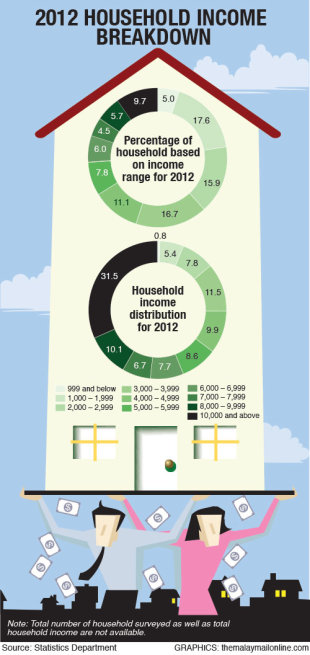
The 9.7 per cent of households in the highest income bracket of RM10,000 per month and above made up 31.5 per cent of overall household income recorded in the country.
In comparison, 17.6 per cent of household incomes, earning between RM1,000 and RM1,999, contributed to only 5.4 per cent of total household income, even though they formed the single largest group.
For the semi-professionals and young professionals, Wong said their main source of income is solely from their salaries as most do not have assets.
“Due to the lifestyle of KL, I don’t think they can make ends meet because the main bulk of their expenses go to car installments.
“I believe they have more than one credit card, which are liabilities, and if they have a family then they have to commit to their children’s education, health insurance and if they can afford, maybe an apartment,” he said.
He added that even earning within that range, they may be considered middle class but they will still struggle financially, with no savings at the end of the month.
He pointed out that based on statistics from Bank Negara, household debt grew close to 13 per cent annually from 2003 to 2013 but Malaysians’ income only grew about five per cent on average.
“So you can see that the growth in income cannot catch up to the growth of household debt,” he said adding that the four main liabilities for most Malaysians are home loans, car loans, credit card debts and personal loans.
Earning RM10,000
USM’s Lean said RM10,000 in an urban setting such as the Klang Valley and Penang would only provide a “standard living”, and not a luxurious one.
She said an example of a typical family with four children’s expenses include: -
House loan: RM3,000
Car loan: RM1,000
Four children: RM2,000 (RM500 each)
Utilities: RM500-RM1,000
Insurance: RM1,000
Transportation: RM1,000
Food: RM1,500-RM2,000
Total = RM10,000 to RM11,000
“Your RM10,000 is not enough to cover, definitely not entertainment, or even holidays in Malaysia.
“Gone are the days when anyone earning RM10,000 was considered rich,” she said.
Middle class group in the past
Dr Lim Teck Ghee, Centre for Policy Initiatives CEO, said rising incomes and relatively low cost of living enabled the middle class to grow in the past.
This is no longer the general rule with urban housing especially out of reach for many on lower incomes, he added.
Wong echoed the same sentiments and said the middle class group were much better off 10 years ago and beyond that.
Back then, most unmarried individuals stayed with their parents, saving on rent at a time when the cost of living was lower, he said.
“Due to the high cost of living, being middle class today doesn’t mean anything.
“It meant something 10 years ago, 20 years ago especially after the economy has been transformed from Third World to developing, we can tell because there were fewer people living in poverty in the 70s, 80s.
“But now it doesn’t mean anything,” he said.
Keep up or risk falling into poverty
Lim said the prospects of upward mobility “look dismal” for many in the middle class especially those self employed or in the informal sector.
“As the government’s record on both affordable housing and quality education has been abysmal and unlikely to improve, the middle class has to gear up for harder times ahead especially when the subsidies on essential goods, petrol, electricity and other items of everyday consumption are reduced or withdrawn,” he warned.
Moving forward, Sunway University’s Wong said the current middle class needs to consider investing their money, as well as upgrading their skills.
“Instead of working for money, they should know how to make money work for them,” he said.
“I think people have to upgrade in terms of their skills of their employment. You cannot forever be stuck at this level. You need to be more productive over time. I think productivity, talent will help you to earn more,” he added.
He also said people should also be looking for opportunities outside of Malaysia, as experience abroad would add to their bargaining power for a higher salary when they return.
The ideal middle class
“I think you need to earn close to RM10,000, of course no debts... it’s a challenge to own a house now,” Wong said.
And for those who live in urban areas, he stressed the importance of being disciplined in their spending.
He said it is important to allocate 10 to 15 per cent of one’s salary to savings and then pay the bills before spending on things which are not considered necessities.
But he acknowledged that being disciplined and not indulging in the luxuries cities like KL have to offer could be a challenge to most.
“But if you want to adopt the KL city type of lifestyle, then you can never save.”
“I think over time, again what is relevant today may not be relevant tomorrow, it doesn’t mean anything.”
“Today we see RM5,000 per month is considered middle class but RM5,000 tomorrow might go down to the bottom 40 per cent,” he said.
The trade off to having less cash, but more luxurious items
Both Wong and USM’s Lean also said the biggest difference between the middle class in the past and those in the group today, is the access to a variety of high-tech consumer products as well as niche services which did not exist 10 years ago.
“No doubt we struggle to make ends meet but we have better quality of life in terms of Internet, better coffee, so you can have these sort of counter arguments.
“Depends on what sort of things you are after,” Wong said.

millionaire mind

Most people work their entire career without becoming a millionaire — but some achieve that level of wealth before turning 30. 
As it turns out, there are a few key characteristics that set certain people up to earn big early on, according to Peter Voogd, founder of the Game Changers Academy, who made his first million before turning 26.
“You don’t make a million by accident,” he says in a recent LinkedIn post. “If it’s not a goal you sure as hell won’t hit it.”
Here are four vital traits young, successful millionaires share, as observed firsthand by Voogd:

They have a sense of urgency.

Young millionaires become successful so early in life because they constantly work toward success instead of waiting for opportunities to come to them. “Now matters more than any other time, and the ‘someday isle’ mentality is killing so many dreams,” Voogd says. Millionaires make monetary success a top priority from day one instead of pushing it to the back burner as something they’d like to achieve someday.

They find a strong mentor. 

Millionaires don’t reach that status alone, and even self-made millionaires find smart, wise mentors to guide them as they build their careers. “Success rises and falls on who you associate with, so make sure you stay aware of your surroundings,” Voogd says. Learning from those who came before you is key to making the right business decisions, and a good mentor will challenge you and help you focus on bigger thinking, Voogd adds.

They focus on leverage.

Time is money, and while the traditional method of trading your time for a proportional payment will earn you a decent salary, it won’t make you a millionaire. “At some point you have to focus on scaling and leverage,” Voogd says. “Investment properties, membership sites, building a brand, partnerships, affiliate marketing, different types of programs, etc.” Young millionaires maximize their time to make sure they’re always earning as much as possible. 

They don’t care what other people think.

“People who care what others think of them will always be limited to others’ opinions,” Voogd says. Young millionaires don’t waste time trying to please people who don’t believe in them or win over those that don’t support them. Instead, they focus on their own vision and learn to believe in themselves. To become truly successful, “you must give up the need to be liked by everybody,” Voogd warns.

Monday, September 8, 2014

sept 8 2014 (i)


it is suppose to be a day of gathering for everyone but instead i receive a news that my grandma got admitted into the hospital

severe enough to go into ICU but not severe enough to cost much problem

she is now safe and sound.. a little fever means her body is reacting to the virus insider her

god bless

of everything that is happening, due to work i have to stay up until 9pm before i can leave office

every time whenever i step to the ground to do my sales, i always tell this to myself

if i'm not a sales.... its really a waste

i'm born a sales person

so i hold a phd degree

and yes, i do have interest in teaching but it is in sales that i excel perfectly

till then

happy mid autumn festival everyone!!

sept 8 2014

Embedded image permalink

Lol~~

really?? what a racist question...

Lol~~

Sunday, September 7, 2014

wwe live event 6 sept 2014


i truly indulge what a true fans does best and join a meet the fan event... i had a blast~!!

i can't wait for the WWE event which will happen this coming october...

i have to thank my sis for tagging along and help me to take some of those pictures

that's one wish cross off my bucket list...

i got a picture and also an autograph.. :)

as saying goes, i will take my foot off the pedal a little this year... i had work very hard in my 20's and its time to enjoy my 30's a little... not saying i take it easy but i'm at least slotting some personal time into my life... lol

to cap this off....

This is AWESOMEEEEEEE~


and yes, the miz did try the durian...